Artificial Intelligence Engineering at BAU: An Educational Model Raising the Technology Specialists of the Future
•
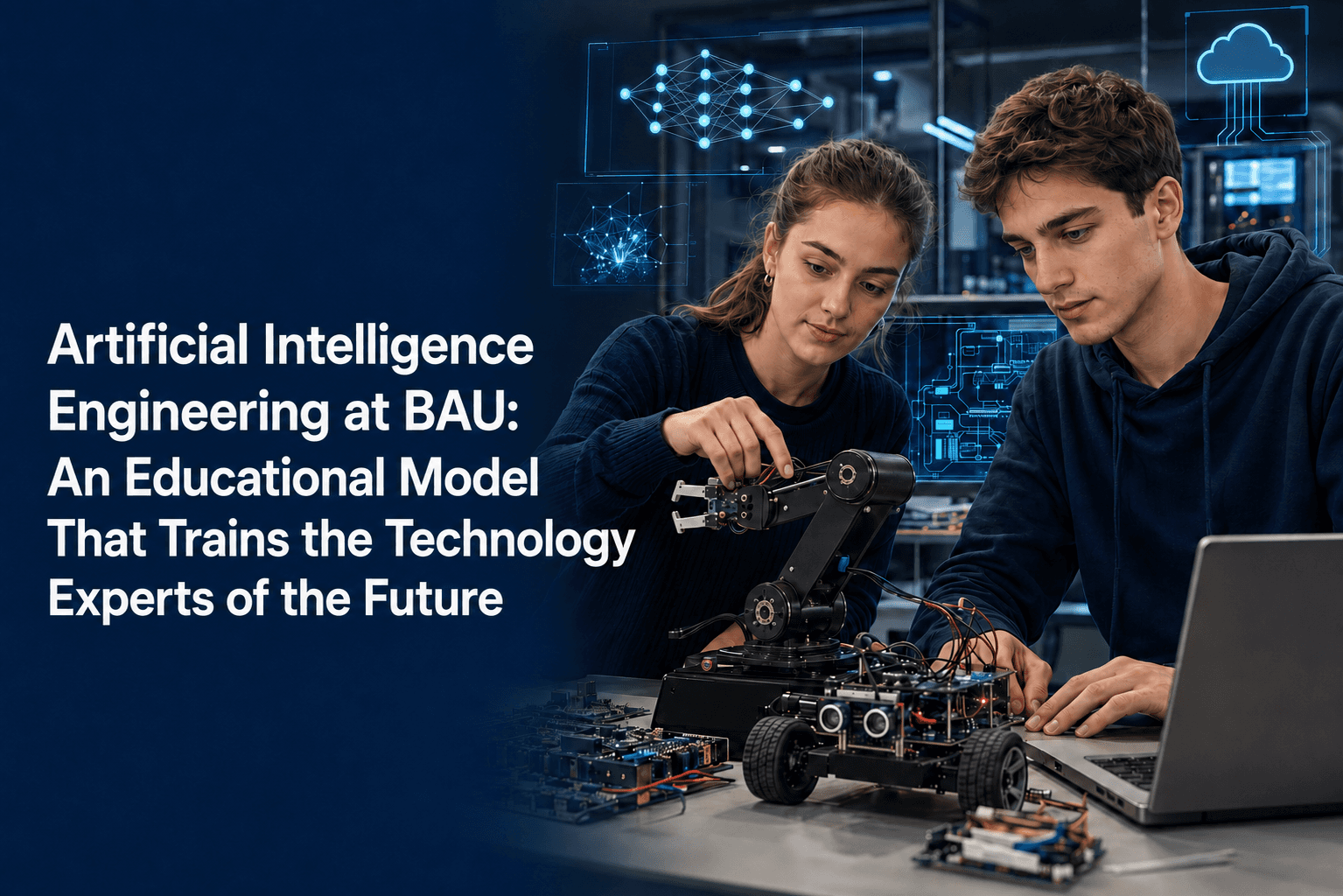
BAU Artificial Intelligence Engineering provides a strong educational foundation for young people who want to design, develop and adapt technology to different industries. Artificial intelligence engineering combines the fundamentals of computer engineering with fields such as data analysis, programming, statistics, optimisation, embedded systems and cloud computing to prepare students for current technological needs. The structure of BAU's programme supports students in both learning theoretical knowledge and reinforcing this knowledge through projects and practical applications.
In the first years of the programme, a strong mathematical and engineering foundation is established with courses such as Calculus, Physics, Discrete Mathematics, Linear Algebra, Probability and Statistics. Python is taught in the Computer Programming I course, and C++ in Computer Programming II. This foundation enables students to be better prepared for subsequent courses such as Data Structures and Algorithms, Principles of Artificial Intelligence and Introduction to Data Science. In this respect, BAU Artificial Intelligence Engineering does not reduce the student to a profile that only writes code; it trains an engineering candidate who understands data, designs models and transfers solutions to different fields.
In the upper years, courses such as Machine Learning, Database Systems and Cloud Computing, Embedded Systems Programming and Deep Learning increase the practical power of the programme. In particular, the course structure moving on the axis of machine learning, data science and cloud computing helps students relate artificial intelligence solutions to real needs. The inclusion of the Computers and Ethics course in the programme is also noteworthy. An engineer developing artificial intelligence is expected to gain awareness of ethical responsibility, decision impact and human-oriented approach as much as technical skills.
The educational objectives on BAU's Artificial Intelligence Engineering page indicate that graduates can work in information technologies, engineering, consultancy and R&D positions; take part in postgraduate research; assume leadership in artificial intelligence projects and establish information technology companies using their entrepreneurial skills. This framework demonstrates that the goal of training technology experts is addressed together with course content, research culture and career vision.
The programme also offers students different development areas such as CO-OP, internships, research laboratories, student projects, study abroad opportunities, minor and double major options. The Summer Training and Capstone Project I-II courses in the final year contribute to the student completing their education process with real project experience. Thus, the student gains the practice of transforming the knowledge they have learned into a product idea, technical solution or research output.
BAU Artificial Intelligence Engineering creates a production-oriented roadmap for students who can think analytically, are interested in science and mathematics, are prone to teamwork, have strong communication skills and are open to new ideas. This structure offers a strong start for the technology experts of the future, both academically and professionally.
Therefore, the programme establishes a planned, applied and future-oriented learning path for students who are curious about technology.
BAU Artificial Intelligence Engineering provides a strong educational foundation for young people who want to design, develop and adapt technology to different industries. Artificial intelligence engineering combines the fundamentals of computer engineering with fields such as data analysis, programming, statistics, optimisation, embedded systems and cloud computing to prepare students for current technological needs. The structure of BAU's programme supports students in both learning theoretical knowledge and reinforcing this knowledge through projects and practical applications.
In the first years of the programme, a strong mathematical and engineering foundation is established with courses such as Calculus, Physics, Discrete Mathematics, Linear Algebra, Probability and Statistics. Python is taught in the Computer Programming I course, and C++ in Computer Programming II. This foundation enables students to be better prepared for subsequent courses such as Data Structures and Algorithms, Principles of Artificial Intelligence and Introduction to Data Science. In this respect, BAU Artificial Intelligence Engineering does not reduce the student to a profile that only writes code; it trains an engineering candidate who understands data, designs models and transfers solutions to different fields.
In the upper years, courses such as Machine Learning, Database Systems and Cloud Computing, Embedded Systems Programming and Deep Learning increase the practical power of the programme. In particular, the course structure moving on the axis of machine learning, data science and cloud computing helps students relate artificial intelligence solutions to real needs. The inclusion of the Computers and Ethics course in the programme is also noteworthy. An engineer developing artificial intelligence is expected to gain awareness of ethical responsibility, decision impact and human-oriented approach as much as technical skills.
The educational objectives on BAU's Artificial Intelligence Engineering page indicate that graduates can work in information technologies, engineering, consultancy and R&D positions; take part in postgraduate research; assume leadership in artificial intelligence projects and establish information technology companies using their entrepreneurial skills. This framework demonstrates that the goal of training technology experts is addressed together with course content, research culture and career vision.
The programme also offers students different development areas such as CO-OP, internships, research laboratories, student projects, study abroad opportunities, minor and double major options. The Summer Training and Capstone Project I-II courses in the final year contribute to the student completing their education process with real project experience. Thus, the student gains the practice of transforming the knowledge they have learned into a product idea, technical solution or research output.
BAU Artificial Intelligence Engineering creates a production-oriented roadmap for students who can think analytically, are interested in science and mathematics, are prone to teamwork, have strong communication skills and are open to new ideas. This structure offers a strong start for the technology experts of the future, both academically and professionally.
Therefore, the programme establishes a planned, applied and future-oriented learning path for students who are curious about technology.
BAU’s AI Infrastructure Prepares Students for a Global Future
Course contents enriched with ChatGPT Edu infrastructure, research supports and personalized learning experience accelerate BAU students’ access to knowledge while empowering them on their journey to becoming a global citizens.
BAU’s AI Infrastructure Prepares Students for a Global Future
Course contents enriched with ChatGPT Edu infrastructure, research supports and personalized learning experience accelerate BAU students’ access to knowledge while empowering them on their journey to becoming a global citizens.

© 2025 Bahçeşehir University – The contents are based on the OpenAI brand policy. All trademarks are the property of their respective owners.
© 2025 Bahçeşehir University – The contents are based on the OpenAI brand policy. All trademarks are the property of their respective owners.
© 2025 Bahçeşehir University – The contents are based on the OpenAI brand policy. All trademarks are the property of their respective owners.