CourseGPT Workshop was held at BAU Faculty of Medicine
•
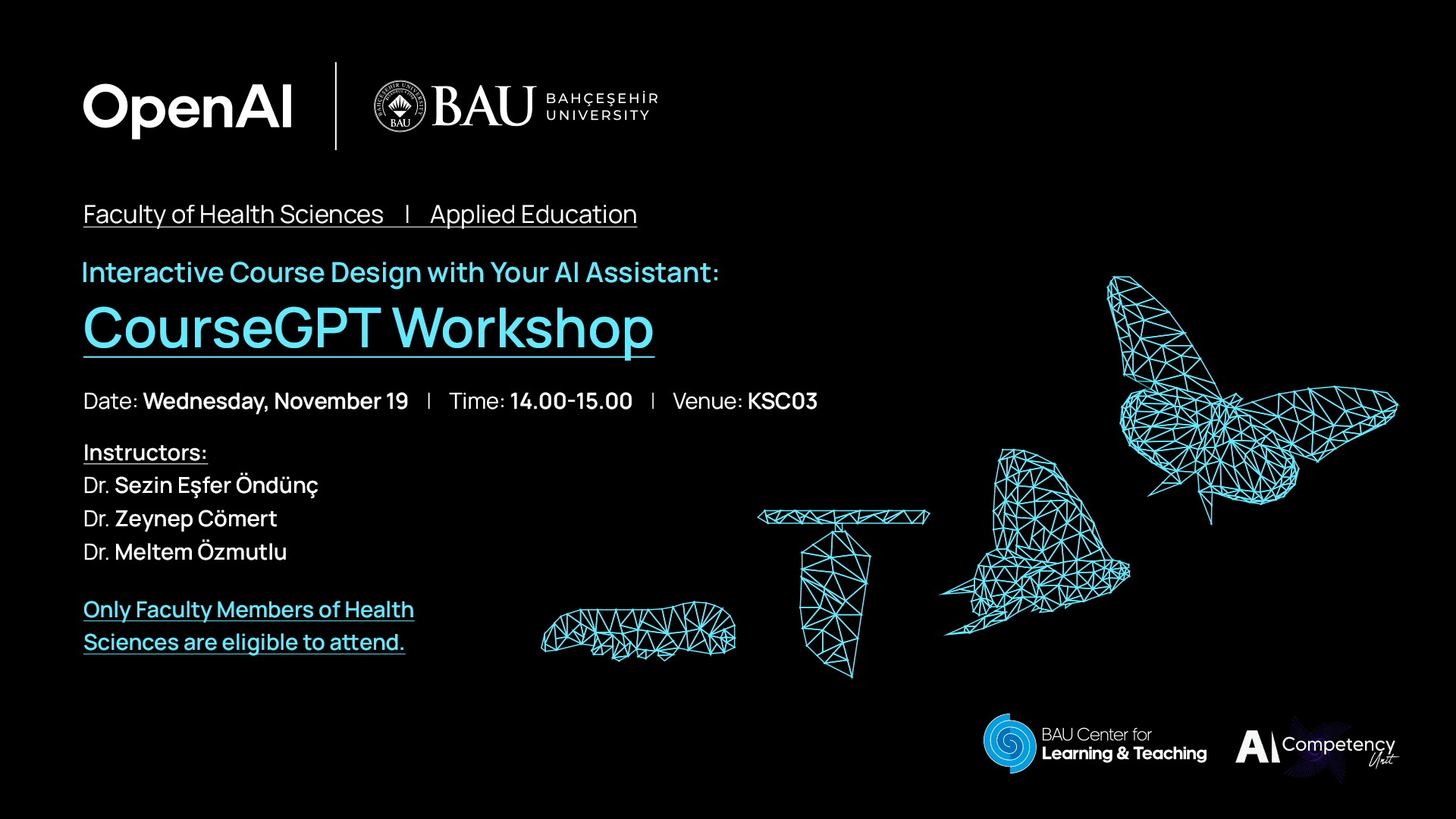
CourseGPT Workshop Conducted at BAU Faculty of Medicine
Bahçeşehir University BAU Faculty of Medicine hosted an important academic event focusing on artificial intelligence-supported educational approaches. The CourseGPT Workshop, organized for faculty members, was successfully conducted in collaboration with OpenAI, the Artificial Intelligence Competency Unit, and the Center for Learning and Teaching (CLT).
The workshop aimed to enhance the pedagogical dimension of artificial intelligence applications in higher education by empowering faculty members' course design processes with innovative tools.
Practical Studies on Artificial Intelligence-Supported Course Assistants
As part of the CourseGPT Workshop, participants engaged in a practical process of developing their own artificial intelligence-supported course assistants similar to CourseGPT. The potential of artificial intelligence to personalize the learning experience, increase student engagement, and dynamically enhance course content was evaluated through example use cases.
Throughout the workshop, faculty members had the opportunity to design artificial intelligence assistants aligned with course objectives, create configurations that could respond to student needs, and develop interactive solutions that support the learning process. This approach stood out as a powerful tool supporting learning efficiency in fields rich in academic content, such as medical education.
CourseGPT Design in Pedagogical and Ethical Framework
One of the main focuses of the workshop was the meaningful, ethically sensitive, and sustainable structuring of artificial intelligence tools from a pedagogical perspective. Participants comprehensively addressed the fundamental principles concerning the responsible use of artificial intelligence in educational environments, alongside technical development processes.
In this context, faculty members evaluated topics such as data security, academic ethics, transparency, and alignment with learning objectives through their own course contexts. Thus, a common approach was developed towards positioning CourseGPT structures as a long-term and reliable educational tool.
Classroom Use Scenarios and Quality Processes
The workshop program also included scenario development activities related to the classroom use of CourseGPT. The integration of artificial intelligence-supported assistants into course delivery, discussion management, assessment and evaluation, and feedback processes was discussed through examples.
Additionally, fundamental quality control steps were shared within the framework of criteria such as content accuracy, consistency, and student engagement. These efforts provided a roadmap for the effective and safe use of the developed CourseGPT structures in educational environments.
Digital Education Approach at BAU Faculty of Medicine
The CourseGPT Workshop served as a strong example reflecting BAU Faculty of Medicine's innovative educational vision and its emphasis on digital pedagogies. This event, where artificial intelligence was considered a strategic learning tool, brought faculty members' academic productions together with contemporary educational models.
Bahçeşehir University continues to steadfastly advance its efforts to enhance the learning experience in higher education through interdisciplinary collaborations and a technology-focused approach.
CourseGPT Workshop Conducted at BAU Faculty of Medicine
Bahçeşehir University BAU Faculty of Medicine hosted an important academic event focusing on artificial intelligence-supported educational approaches. The CourseGPT Workshop, organized for faculty members, was successfully conducted in collaboration with OpenAI, the Artificial Intelligence Competency Unit, and the Center for Learning and Teaching (CLT).
The workshop aimed to enhance the pedagogical dimension of artificial intelligence applications in higher education by empowering faculty members' course design processes with innovative tools.
Practical Studies on Artificial Intelligence-Supported Course Assistants
As part of the CourseGPT Workshop, participants engaged in a practical process of developing their own artificial intelligence-supported course assistants similar to CourseGPT. The potential of artificial intelligence to personalize the learning experience, increase student engagement, and dynamically enhance course content was evaluated through example use cases.
Throughout the workshop, faculty members had the opportunity to design artificial intelligence assistants aligned with course objectives, create configurations that could respond to student needs, and develop interactive solutions that support the learning process. This approach stood out as a powerful tool supporting learning efficiency in fields rich in academic content, such as medical education.
CourseGPT Design in Pedagogical and Ethical Framework
One of the main focuses of the workshop was the meaningful, ethically sensitive, and sustainable structuring of artificial intelligence tools from a pedagogical perspective. Participants comprehensively addressed the fundamental principles concerning the responsible use of artificial intelligence in educational environments, alongside technical development processes.
In this context, faculty members evaluated topics such as data security, academic ethics, transparency, and alignment with learning objectives through their own course contexts. Thus, a common approach was developed towards positioning CourseGPT structures as a long-term and reliable educational tool.
Classroom Use Scenarios and Quality Processes
The workshop program also included scenario development activities related to the classroom use of CourseGPT. The integration of artificial intelligence-supported assistants into course delivery, discussion management, assessment and evaluation, and feedback processes was discussed through examples.
Additionally, fundamental quality control steps were shared within the framework of criteria such as content accuracy, consistency, and student engagement. These efforts provided a roadmap for the effective and safe use of the developed CourseGPT structures in educational environments.
Digital Education Approach at BAU Faculty of Medicine
The CourseGPT Workshop served as a strong example reflecting BAU Faculty of Medicine's innovative educational vision and its emphasis on digital pedagogies. This event, where artificial intelligence was considered a strategic learning tool, brought faculty members' academic productions together with contemporary educational models.
Bahçeşehir University continues to steadfastly advance its efforts to enhance the learning experience in higher education through interdisciplinary collaborations and a technology-focused approach.
BAU’s AI Infrastructure Prepares Students for a Global Future
Course contents enriched with ChatGPT Edu infrastructure, research supports and personalized learning experience accelerate BAU students’ access to knowledge while empowering them on their journey to becoming a global citizens.
BAU’s AI Infrastructure Prepares Students for a Global Future
Course contents enriched with ChatGPT Edu infrastructure, research supports and personalized learning experience accelerate BAU students’ access to knowledge while empowering them on their journey to becoming a global citizens.

© 2025 Bahçeşehir University – The contents are based on the OpenAI brand policy. All trademarks are the property of their respective owners.
© 2025 Bahçeşehir University – The contents are based on the OpenAI brand policy. All trademarks are the property of their respective owners.
© 2025 Bahçeşehir University – The contents are based on the OpenAI brand policy. All trademarks are the property of their respective owners.